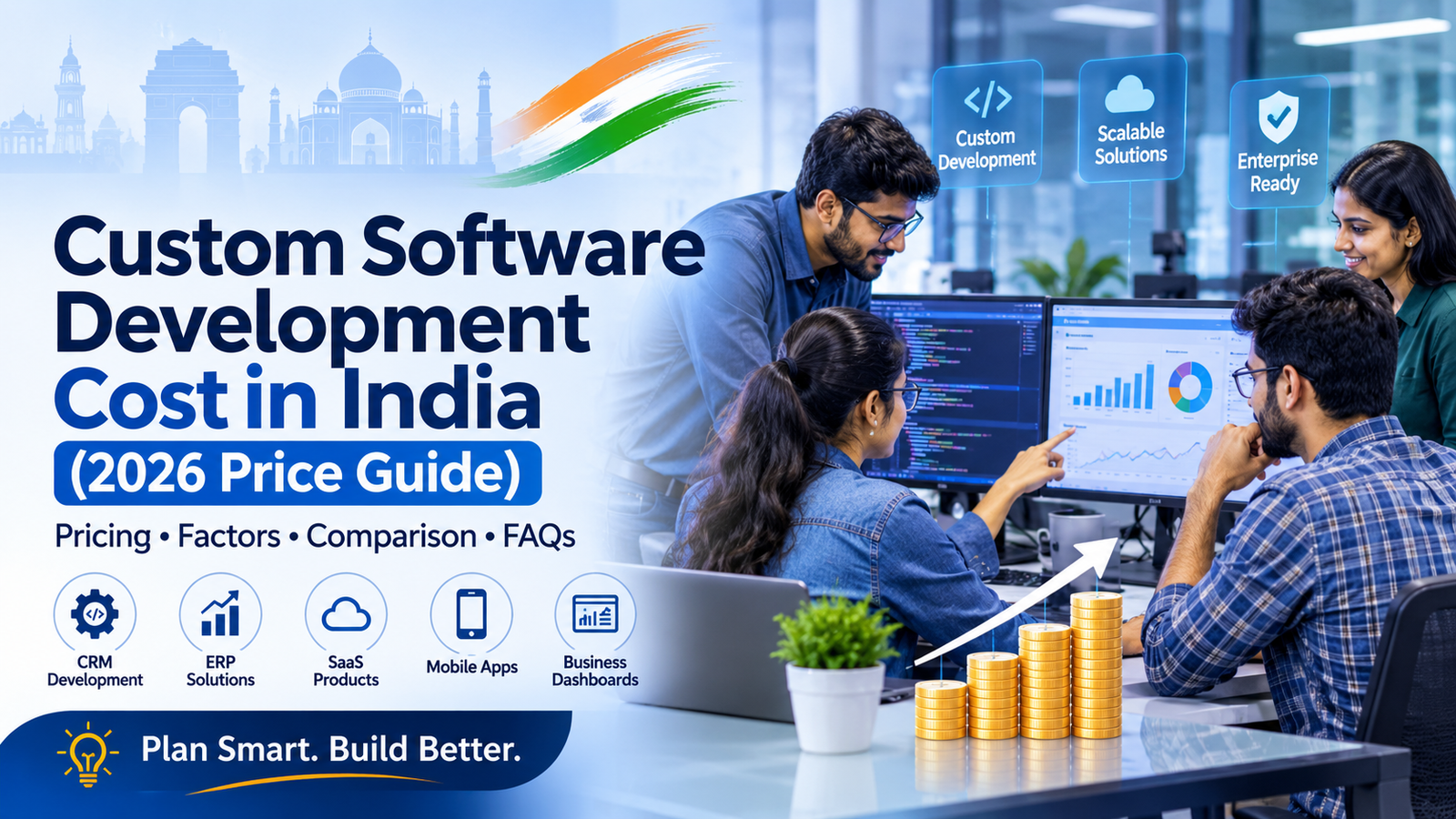
Custom Software Development Cost in India (2026 Price Guide)
Businesses across India are investing in digital solutions to automate daily operations, improve productivity, manage customers, and make better business decisions. From customer relationship management (CRM) systems to enterprise resource planning (ERP) platforms, custom software helps companies build workflows around their specific requirements.
One of the first questions businesses ask before starting a project is: How much does custom software development cost in India in 2026?
The answer depends on several factors, including software complexity, the number of features, user roles, third-party integrations, security requirements, and ongoing support.
As an indicative budgeting guide, a relatively simple custom application may cost around ₹1.5 lakh to ₹5 lakh, while a more advanced business application may require ₹5 lakh to ₹20 lakh or more. Large ERP systems, multi-platform products, and enterprise applications can cost several tens of lakhs or exceed ₹1 crore, depending on their scope. These are planning estimates rather than standardized industry prices.
In this guide, we explain custom software development pricing in India, compare estimated costs across project types, explore the factors that affect your budget, and share practical ways to plan your investment.
How Much Does Custom Software Development Cost in India in 2026?
Custom software development in India can range from a few lakh rupees for a focused business tool to over ₹1 crore for a complex enterprise platform. The final quotation depends on the features, technical architecture, development team, testing requirements, integrations, and deployment environment.
The following table provides indicative budget ranges for different types of projects.
Custom Software Development Cost by Project Type
Software type | Estimated development cost | Approximate timeline |
|---|---|---|
Basic internal business tool | ₹1.5 lakh–₹5 lakh | 4–10 weeks |
Custom dashboard or admin panel | ₹2 lakh–₹8 lakh | 4–12 weeks |
Inventory management software | ₹4 lakh–₹15 lakh | 2–4 months |
Custom CRM software | ₹5 lakh–₹20 lakh | 2–5 months |
HR management software | ₹5 lakh–₹20 lakh | 2–5 months |
Billing or POS software | ₹3 lakh–₹12 lakh | 6–16 weeks |
Custom customer portal | ₹5 lakh–₹20 lakh | 2–5 months |
Custom ERP software | ₹10 lakh–₹40 lakh+ | 4–9+ months |
SaaS product or web application | ₹8 lakh–₹30 lakh+ | 3–8+ months |
Complex enterprise platform | ₹30 lakh–₹1 crore+ | 6–18+ months |
A basic internal tool usually requires fewer screens, workflows, and integrations than a multi-department ERP system. Similarly, a first version of a SaaS product may cost less than a mature platform with advanced analytics, subscription billing, extensive permissions, and high-volume infrastructure.
The best approach is to estimate the cost according to your actual requirements instead of choosing a software category based on its name alone.
What Factors Affect Custom Software Development Cost in India?
Two software projects may appear similar but receive very different quotations. A dashboard with basic reporting is not the same as a dashboard connected to accounting software, payment systems, customer records, and automated approval workflows.
Understanding the main cost drivers helps you plan a realistic budget.
1. Software Features and Functional Requirements
The number and complexity of features have a direct impact on development effort.
A basic business application might include login functionality, a dashboard, data entry forms, and simple reports. An advanced application may require automated workflows, notifications, detailed analytics, document management, approval processes, and custom reporting.
For example, a simple lead management system may track customer names and contact details. A more advanced CRM could include lead assignment, sales pipelines, reminders, email integration, performance reports, and role-based access.
Before requesting a quotation, list the essential features and separate them from features that can be introduced later.
2. Software Complexity and Architecture
Software complexity depends on how different components work together.
A single-purpose application with a limited number of users is generally easier to build than a multi-department system with interconnected modules and complex business rules.
Projects become more demanding when they require:
Multiple user roles and permissions.
Advanced reporting and analytics.
Automated approval workflows.
Real-time data synchronization.
High-volume transactions.
Multiple branches or business locations.
Strong audit trails and access controls.
The architecture should match your current needs while allowing for reasonable future growth.
3. UI/UX Design and User Experience
User interface and user experience design affect both the cost and usability of custom software.
A straightforward admin panel may require only a few screens and standard components. A customer-facing application or enterprise dashboard may need detailed user journeys, interactive prototypes, responsive layouts, and usability testing.
Good design helps employees complete tasks efficiently and reduces confusion during adoption. It is particularly important for applications used daily by sales teams, operations staff, customers, and management.
4. Third-Party Integrations
Integrations allow software to exchange information with other platforms and services.
Examples include:
Payment gateways.
Accounting and billing systems.
Email and SMS services.
WhatsApp messaging APIs.
CRM and ERP platforms.
Shipping and logistics services.
External APIs and reporting tools.
Integration costs depend on API availability, documentation, authentication, data mapping, synchronization rules, error handling, and testing. Connecting two systems is not always a simple plug-and-play process.
5. Web Application, Mobile App, or Both
The platforms you need can significantly affect the overall development budget.
A browser-based web application may be sufficient for office teams working on desktops and laptops. A mobile application may be more suitable for field sales representatives, delivery personnel, service technicians, or customers who need access while travelling.
If you need web, Android, and iOS versions, consider the additional work required for mobile-specific interfaces, device testing, notifications, offline functionality, and deployment.
6. Data Security and Compliance Requirements
Security requirements should be considered from the beginning rather than added after development.
Depending on the application, requirements may include secure authentication, role-based permissions, encryption, audit logs, backups, data retention controls, vulnerability testing, and compliance-related processes.
Applications that handle financial information, sensitive customer records, or large volumes of business data may require additional design, testing, and security reviews.
7. Development Team and Engagement Model
The cost also depends on who builds the software and how the project is managed.
Development option | Potential advantage | What to evaluate |
|---|---|---|
Independent freelancer | Direct communication and potentially lower overhead | Availability, testing, documentation, continuity |
Small development agency | Coordinated design, development, and testing | Team expertise, project management, support |
Mid-sized development company | Broader specialist capabilities | Delivery process, communication, total quotation |
Large IT services company | Resources for complex enterprise projects | Minimum engagement size, overhead, contract terms |
In-house team | Direct control over ongoing development | Recruitment, salaries, management, infrastructure |
The lowest initial quotation is not always the least expensive option over the life of the software. Compare deliverables, code ownership, testing, documentation, maintenance, and post-launch support before making a decision.
Custom Software Development Cost by Business Application
The following examples explain what different business applications may involve and why their prices vary.
1. Custom CRM Software Development Cost
CRM software helps businesses manage leads, customer relationships, sales activities, follow-ups, and reporting in one system.
A basic CRM may include contact management, lead tracking, and a sales pipeline. An advanced CRM may add automated reminders, team assignments, dashboards, communication integrations, and custom reporting.
CRM complexity | Indicative cost |
|---|---|
Basic lead and contact management | ₹2 lakh–₹5 lakh |
CRM with sales pipeline and reporting | ₹5 lakh–₹12 lakh |
Advanced CRM with integrations and automation | ₹12 lakh–₹25 lakh+ |
These estimates assume a custom-built solution rather than a standard subscription-based CRM. The scope of automation, number of users, and complexity of integrations will affect the final price.
2. Custom ERP Software Development Cost
ERP software connects business operations such as inventory, purchasing, sales, finance, production, and human resources.
A small business may begin with a few essential modules, while a larger organization may require multiple departments to share data and follow interconnected approval workflows.
ERP complexity | Indicative cost |
|---|---|
One or two focused modules | ₹4 lakh–₹10 lakh |
Multi-module business ERP | ₹10 lakh–₹40 lakh |
Complex enterprise ERP | ₹40 lakh–₹1 crore+ |
ERP costs can rise when the project includes legacy data migration, multiple branches, accounting integrations, complex permissions, and specialized operational workflows.
A phased implementation is often a practical way to manage the budget while allowing teams to adopt the system gradually.
3. Custom Inventory Management Software Cost
Inventory management software helps businesses track stock levels, purchases, sales, warehouses, and product movement.
A basic solution may manage products and stock entries. More advanced systems can include barcode scanning, multiple warehouses, reorder alerts, batch tracking, supplier management, and integration with billing or accounting platforms.
Indicative cost: ₹3 lakh–₹15 lakh or more.
The price depends on inventory complexity, warehouse requirements, transaction volume, reporting needs, and integrations.
4. Custom HR Management Software Cost
HR software can streamline employee records, attendance, leave management, recruitment, payroll workflows, and performance tracking.
A focused HR tool may support employee records and leave requests. A comprehensive platform may include attendance devices, shift management, payroll calculations, statutory reporting, employee self-service, and approval workflows.
Indicative cost: ₹3 lakh–₹20 lakh or more.
Payroll and compliance-related features need careful specification because business rules, integrations, and changing requirements can increase development and maintenance effort.
5. SaaS Product Development Cost
A Software as a Service (SaaS) product allows users to access an application online, often through a subscription.
A SaaS minimum viable product (MVP) typically focuses on the core features needed to test the product with initial customers. A mature SaaS platform may require tenant separation, subscription billing, usage limits, analytics, automated onboarding, and scalable infrastructure.
SaaS scope | Indicative cost |
|---|---|
Focused proof of concept | ₹2 lakh–₹5 lakh |
Functional SaaS MVP | ₹8 lakh–₹20 lakh |
Feature-rich SaaS platform | ₹20 lakh–₹50 lakh+ |
A proof of concept is not equivalent to a production-ready SaaS product. Budget separately for hosting, monitoring, security, third-party APIs, and ongoing improvements.
How Much Do Software Developers Charge in India in 2026?
Hourly billing is one way to estimate software development costs, particularly when requirements may change during the project.
Public 2026 pricing guides report broad variations in Indian development rates by seniority, specialization, and provider type. For initial budgeting, the following ranges can serve as illustrative estimates.
Specialist or role | Indicative hourly rate |
|---|---|
Junior developer | ₹500–₹1,200 |
Mid-level developer | ₹800–₹2,000 |
Senior developer | ₹1,500–₹3,500 |
UI/UX designer | ₹700–₹2,000 |
QA or test engineer | ₹500–₹1,800 |
Technical lead or architect | ₹2,000–₹4,500+ |
DevOps or cloud specialist | ₹1,200–₹3,800 |
Rates overlap because experience, specialization, agency overhead, contract terms, and project requirements vary. These are indicative budgeting figures, not a verified national rate card. Confirm whether a provider quotes hourly, daily, monthly, or project-based pricing.
For example, a project involving 400 hours of work at a blended rate of ₹1,500 per hour would have an estimated labour cost of ₹6,00,000.
That calculation does not automatically include every expense. Confirm whether the quotation also covers discovery, project management, design, testing, deployment, third-party services, and post-launch support.
Hidden Costs to Consider Before Developing Custom Software
The initial development quotation is only one part of the total cost of owning software.
Businesses should also consider the expenses involved in deploying, operating, maintaining, and improving the application.
Expense | What it may cover |
|---|---|
Hosting and cloud infrastructure | Servers, storage, databases, backups |
Domain and SSL | Domain registration and applicable certificate costs |
Third-party services | Email, SMS, payment, maps, or API charges |
Maintenance | Bug fixes, compatibility updates, routine improvements |
Security | Vulnerability checks, monitoring, and security updates |
New features | Enhancements after the initial release |
Data migration | Importing, cleaning, and validating existing records |
Training and documentation | Helping employees use the software correctly |
Taxes | Applicable GST and other contractual charges |
Some of these costs may be included in a development package, while others may be billed separately. Ask for a written breakdown before approving the project.
How Much Does Software Maintenance Cost?
Maintenance costs vary according to software complexity, infrastructure, service-level commitments, and the frequency of updates.
For preliminary budgeting, a business might set aside around 10%–20% of the initial development cost annually for routine maintenance and support. This is a planning assumption, not a universal market rate. Major upgrades, new modules, infrastructure growth, and extensive support agreements can cost more.
For example, if the initial development investment is ₹10 lakh, an annual maintenance budget of ₹1 lakh–₹2 lakh could be a starting point for discussion. Request a separate estimate based on the support services you actually need.
How to Reduce Custom Software Development Cost Without Compromising Quality
Reducing software costs does not mean choosing the cheapest developer or removing essential quality checks. It means investing in the features that solve your most important business problems first.
1. Start With a Minimum Viable Product
An MVP includes the essential features required to deliver value and test the solution with real users.
Instead of building every planned feature at once, start with the core workflow. Add advanced reporting, additional integrations, and secondary modules after evaluating the initial release.
2. Define Your Requirements Clearly
Unclear requirements can lead to repeated revisions, additional development hours, and unexpected expenses.
Before development begins, document:
The business problem the software must solve.
The user roles and permissions required.
The essential features and workflows.
The reports and dashboards needed.
The integrations with existing systems.
The expected deliverables and acceptance criteria.
A clear scope makes it easier to compare quotations and control changes.
3. Prioritize Features by Business Value
Divide planned features into three groups:
Essential: Required for the first release.
Important: Valuable but not necessary for launch.
Future enhancements: Features that can be added later.
This approach helps prevent scope expansion and keeps the first development phase focused.
4. Use Proven Technologies and Components
Established frameworks, reusable components, and reliable third-party services can reduce development effort when they suit the project’s requirements.
However, technology decisions should also consider security, licensing, integration requirements, scalability, and long-term maintenance.
5. Compare Detailed Quotations
When comparing software development companies, check whether their quotations cover the same features and deliverables.
Ask each provider about testing, source-code ownership, documentation, deployment, warranties, maintenance, payment milestones, and additional charges.
A detailed quotation makes it easier to understand why prices differ and which solution offers the best long-term value.
How to Choose the Right Software Development Company in India
Selecting a development partner is an important decision because software quality can affect business operations long after launch.
Before hiring a company, consider the following criteria.
Relevant experience: Look for experience with similar applications, workflows, or integrations.
Transparent pricing: The proposal should identify the project scope, deliverables, exclusions, and payment milestones.
Technical capabilities: Confirm that the team can handle your application’s architecture, security, integrations, and performance requirements.
Testing and quality assurance: Ask how the company tests functionality, permissions, integrations, and important user workflows.
Communication and project management: Establish how often progress will be shared and how requirements or changes will be approved.
Ownership and documentation: Confirm your rights to the source code, database, documentation, and other project assets in the contract.
Post-launch support: Understand what happens after deployment, including defect resolution, maintenance, and future feature development.
The right partner should be able to explain technical decisions in business terms and provide a realistic plan for delivering the agreed scope.
Our Custom Software Development Process
A structured development process helps businesses understand what they are paying for and how the project will progress.
Step 1: Requirement Analysis
Define the business objectives, user roles, workflows, features, integrations, and project priorities.
Step 2: Planning and UI/UX Design
Prepare the technical plan, application structure, screen layouts, and user journeys.
Step 3: Software Development
Build the frontend, backend, database, business logic, and required integrations.
Step 4: Testing and Quality Assurance
Test functionality, permissions, integrations, performance, and identified issues before release.
Step 5: Deployment and Support
Deploy the application, provide agreed documentation, assist with onboarding, and establish a maintenance plan.
The duration of each stage depends on the project scope, feedback cycles, and availability of required business information.
Custom Software Development Services for Your Business
Every business has different operational challenges. Some need a CRM to manage leads and follow-ups, while others need ERP software to coordinate departments, inventory systems to track stock, or a custom application to deliver a new digital service.
The right solution begins with understanding the workflow, identifying the features that matter most, and selecting an architecture that fits the budget and future requirements.
Explore our Software Development Services to learn more about custom software solutions for business operations, automation, and digital growth.
Whether you are a startup planning your first product or an established company modernizing its internal systems, a clearly defined development scope can help you make informed investment decisions.
Ready to plan your software project? Start by documenting your requirements, essential features, expected users, integrations, and budget. These details will make it easier to obtain a realistic estimate for your project.
Frequently Asked Questions (FAQs)
1. What is the average custom software development cost in India in 2026?
There is no single reliable average for every type of custom software. As an indicative guide, a basic business tool may cost ₹1.5 lakh–₹5 lakh, a more advanced business application may cost ₹5 lakh–₹20 lakh, and a complex ERP or enterprise platform may cost ₹30 lakh to ₹1 crore or more. The actual quotation depends on scope, integrations, complexity, and delivery requirements.
2. How much does custom software development cost for a small business in India?
A small business might budget approximately ₹2 lakh–₹8 lakh for a focused custom application with essential features. Applications requiring advanced automation, multiple modules, extensive integrations, or mobile support may cost more. A detailed requirement assessment is needed to establish a suitable budget.
3. How long does custom software development take?
A relatively simple application may take around 4–10 weeks, while a mid-complexity business application may take 2–5 months. Complex ERP systems and enterprise platforms can take six months or longer. These are indicative timelines and may change with project scope, testing, approvals, and integrations.
4. Is custom software more expensive than ready-made software?
Custom software generally requires a larger upfront investment because it is designed around specific business requirements. Ready-made software can be more economical for standard workflows, but subscription fees, licensing, per-user charges, customization, and integration costs should also be considered. Custom development may be worthwhile when existing products cannot adequately support essential workflows.
5. What is included in custom software development pricing?
Depending on the contract, the price may include requirement analysis, UI/UX design, programming, database development, integrations, testing, and deployment. Hosting, third-party services, taxes, training, maintenance, and future enhancements may be excluded. Always verify the deliverables and exclusions in writing.
6. How much does custom CRM software cost in India?
A basic custom CRM may cost approximately ₹2 lakh–₹5 lakh, while a CRM with sales pipelines, reporting, automation, and integrations may cost ₹5 lakh–₹20 lakh or more. Advanced requirements, such as complex permissions, multiple business units, and specialized integrations, can increase the total cost.
7. How much does custom ERP software cost in India?
A focused ERP implementation may start around ₹4 lakh–₹10 lakh for one or two modules. A multi-module ERP may require ₹10 lakh–₹40 lakh, while a complex enterprise solution can exceed ₹1 crore. Costs depend on the number of modules, data migration, workflows, integrations, and operational complexity.
8. Is GST included in custom software development costs?
Not necessarily. Some providers quote prices before GST, while others may present tax-inclusive estimates. Ask for a written quotation that clearly separates development charges, applicable taxes, hosting, third-party costs, and maintenance.
9. Can I develop custom software with a limited budget?
Yes. One practical approach is to launch an MVP containing only the essential features, then expand in phases. A clearly defined scope, proven technology choices, and early testing can help reduce unnecessary rework without sacrificing important quality and security requirements.
10. How do I get an accurate software development quotation?
Prepare a brief describing your business problem, user roles, essential features, integrations, platforms, expected timeline, and budget. A software development team can use this information to assess complexity, identify risks, and provide a more meaningful estimate with defined deliverables.
Conclusion
The custom software development cost in India in 2026 depends on what you need to build, how complex the solution is, and how it will be maintained after launch. A focused business tool may require a few lakh rupees, while advanced CRM, ERP, SaaS, and enterprise solutions can require substantially larger investments.
Rather than selecting a development company based on price alone, compare the proposed scope, technical approach, testing process, ownership terms, and ongoing support.
A well-planned project starts with clear business objectives and a realistic budget. By prioritizing essential features and developing in manageable phases, businesses can invest in software that addresses immediate needs while allowing room for future growth.