
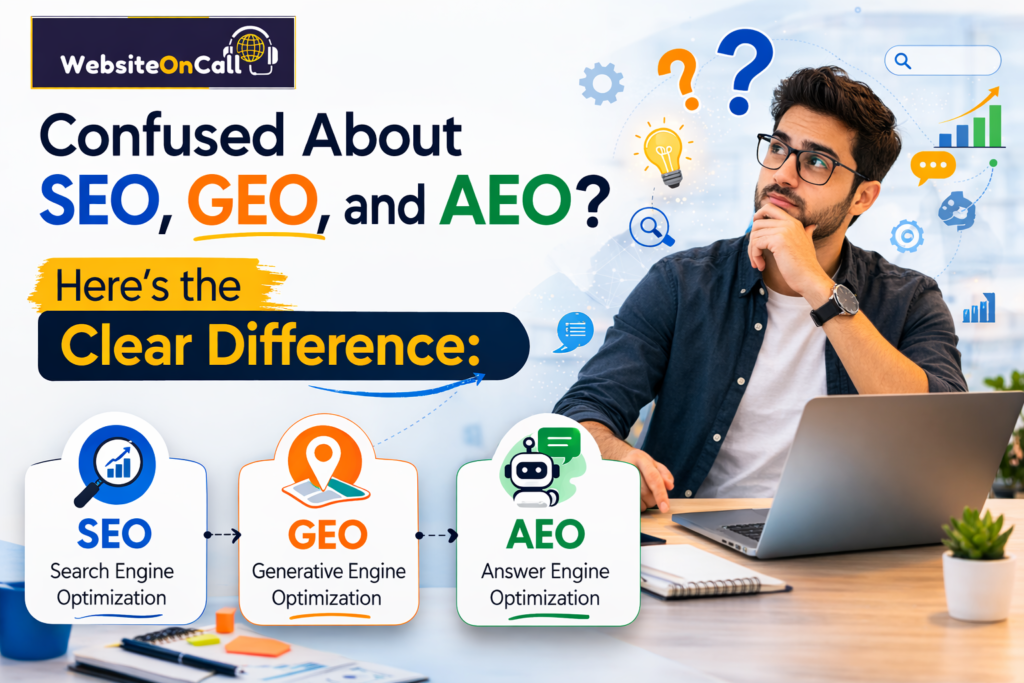
Confused About SEO, GEO, and AEO? Here’s the Clear Difference
Strategically increasing visibility used to be simple, and many marketers relied on search engine optimization (SEO) to do the job. Because there are varying search technology systems today, SEO has changed to become a multi-layered framework that incorporates GEO (Generative Engine Optimization) and AEO (Answer Engine Optimization) and other components. This framework determines the discovery, credibility, and presentation of particular content to users. Organizations that appreciate the nuances of these frameworks build a sustainable edge over rivals in acquiring traffic, building authority, and improving conversions. Here, we delineate these optimization frameworks, and clarify their roles, principles, and importance.
What Is SEO (Search Engine Optimization)?
SEO is the practice of improving and promoting digital content so that it ranks high on conventional search engine result pages (SERPs). SEO attempts to match web pages to the criteria search engines use to assess relevance, authority, usability, and other technical factors.
Core Components of SEO
1. Search Engine Optimization for content
This includes improving elements on a web page which in turn increases relevance and readability :
- Strategic keyword placement
- Optimized title tags and meta descriptions
- Structured headings (H1–H6)
- Internal linking architecture
- High-quality, authoritative content
2. Technical search engine optimization
Technical issues which search engines’ crawlers’ performance, indexing of, and access to is improved:
- Site speed optimization
- Mobile responsiveness
- Secure HTTPS protocols
- XML sitemaps and robots directives
- Structured data markup
3. On-Page Authority Signals
External factors which support credibility and rank:
- High-quality backlinks
- Brand mentions
- Digital PR
- Social signals
Primary Objective of SEO
The goal is straightforward: Rank better for target keywords and see more organic traffic from search engines. SEO is still the base of what we do because at the start of most people’s journey they are still typing in queries.
What Is AEO (Answer Engine Optimization)?
AEO involves optimizing content to enable search engines to retrieve exact answers and show them to users without a click. This strategy aims at featured snippets, responses to voice search, and knowledge panels
Why AEO Matters
Modern users are for instant answers which are accurate and to the point as opposed to a list of links. Search engines in response are giving what is essentially a summary of the best answer which they present at the top of search results.
Keys AEO Strategies
1. Structured, Issue Based Content
Content which answers your questions in clear concise forms:
- FAQ sections
- Step-by-step guides
- Definitions and summaries
- Internal linking architecture
2. Schema implementation
Structured data aids in the interpretation of context by engines and accurate answer extraction:
- FAQ schema
- How-to schema
- Q&A structured data
- Entity markup
3. Voice Search Optimization for Conversations
Voice assistants prioritize natural language responses: Voice assistants use natural language:
- Long-tail conversational phrases
- Direct answer sentences
- Contextual clarity
Primary Objective of AEO
The aim is to be the go to answer for all questions which will present zero click results and voice assistant responses.
What is GEO (Generative Engine Optimization)?
GEO is the newest field applicable to AI discovery systems that respond rather than simply retrieving documents. These generative engines create responses based upon the assimilation of information from a variety of sources.

Prioritization of Content by Generative Engines
AI systems give precedence to content which shows:
- Expertise and authority
- Structured presentation and factual accuracy
- Contextual thoroughness
- Cross source reliability
Keys AEO Strategies
1. Rich in entities, Contextual Writing
Generative models that are to say do not simply present keywords. Instead content should clearly put forth what the entities are, what processes take place, and how they are connected.
2. Authoritative tone and supported claims.
AI systems prefer information which is put forth in a credible, neutral, and well supported way.
3. In depth coverage of topics.
Superficial work is what you get out of thin air. What goes in deep is what shows expertise.
4. Natural Language Clarity
Content that answers complex questions in great detail, not what targets only certain search terms.
Primary Objective of GEO
The aim is to ensure content becomes a trusted source used by AI systems when generating responses.
SEO vs. AEO vs. GEO: The Strategic Differences
| Dimension | SEO | AEO | GEO |
|---|---|---|---|
| Primary Platform | Traditional search engines | Answer boxes & voice assistants | AI generative systems |
| User Behavior | Clicking links | Receiving direct answers | Consuming synthesized responses |
| Content Style | Keyword-optimized | Concise and structured | Context-rich and authoritative |
| Goal | Traffic acquisition | Visibility without clicks | Inclusion in AI outputs |
Why Businesses Must Integrate All Three
Using a single optimization approach is limiting. Today search is conducted across many interfaces typed in queries, spoken questions, and AI conversations.
Comprehensive Visibility Strategy
SEO which puts you on the map in search results.
AEO what we do to get featured in direct answers.
GEO we put out content that is a go to for AI.
Companies which implement these see success in digital authority across platforms.
Content features that consistently perform across SEO, AEO, and GEO
Some features which constantly do so:
1. Subject Matter Depth
Comprehensive coverage is a mark of expertise and also increases trust.
2. Clear Information Architecture
Logical structure, summaries, and organized sections improve machine interpretation.
3. Semantic Richness
Using synonyms and context based explanations improves algorithm performance.
4. Credibility Signals
Original research, precise data, and professional tone improve authority.
5. User Intent Alignment
Content that is of value to what users are looking for info, comparison, or solutions.
Common Mistakes That Reduce Visibility
Organizations which put out mostly what is old and worn out in terms of tactics see to damage performance. Focusing too much on keywords at the expense of substance.
- Thin content lacking depth
- Ignoring structured data
- Writing for algorithms rather than readers
- Neglecting conversational queries
Steer clear of these issues which is key to staying relevant as search technologies change.
Future Outlook: The Convergence of Discovery Systems
Search, answers, and AI generation are coming together as one integrated discovery experience. More and more platforms are putting together classic indexing and real-time synthesis.
Emerging Trends
Multi modal search which includes text, voice, and visual elements.
Personalized AI assistants delivering curated responses
Increased emphasis on expertise and trustworthiness
Reduced reliance on simple keyword matching
Organizations which adopt early will lead in the future visibility landscapes.
Practical Framework for Implementation
To attain complete discoverability, a multi-layered approach is suggested:
Foundation: SEO
- Build fast, crawlable, and technically sound sites
- Target intended keywords
- Create content hubs that are authoritative
Enhancement: AEO
- Insert structured FAQs and brief answer as well as
- conversational query optimization
- schema markup
Expansion: GEO
- Create complete and authoritative resources
- that are factually accurate
- establish yourself as a leader on the topic.
Summary
As each of SEO, AEO, and GEO disciplines reflects distinct mechanisms of discovery, their differences can no longer be ignored. Combined, they offer a full visibility framework. Companies developing contextually relevant, authoritative, and richly structured content will win in legacy search engines, answer engines, and AI-based platforms. By aligning our strategies with the current processes of retrieving, summarizing, and generating information, we ensure our long-term digital visibility in a rapidly evolving intelligent search ecosystem.